Which legal structure suits your business best?
Choosing between registering as a self-employed individual or setting up a company is one of the most important decisions when starting a business. This choice directly affects your taxes, legal responsibilities, costs, and growth potential.
In this article, we analyze the key differences between being self-employed and forming a company to help you make the best decision based on your situation.
1. What does it mean to be self-employed?
A self-employed individual is a natural person who carries out an economic activity on a regular, personal, and direct basis.
Advantages of being self-employed
- Simple and quick setup process
- Low initial cost
- Fewer accounting obligations
- Ideal for starting small projects or validating ideas
Disadvantages
- Unlimited liability: you are responsible with all your personal assets
- Higher tax burden as profits grow
- Lower perception of professionalism in some sectors
2. What is a company?
A commercial company (usually a Limited Liability Company – LLC) is a legal entity separate from its shareholders.
Advantages of creating a company
- Limited liability: your personal assets are protected
- Better professional image
- Greater potential for growth, investment, and partners
- More stable taxation when profits are high
Disadvantages
- Greater administrative complexity
- Higher initial costs
- More tax and accounting obligations
3. Key differences between self-employed and company
| Aspect | Self-employed | Company |
|---|---|---|
| Setup process | Simple | More complex |
| Initial cost | Low | Medium–high |
| Liability | Unlimited | Limited |
| Taxes | Personal Income Tax (IRPF) | Corporate Income Tax |
| Image | More informal | More professional |
| Growth | Limited | High |
4. Which option suits your type of business?
Choose self-employed if:
- You are just starting out
- You have low initial investment
- Your income does not exceed €40,000 per year
- You work alone or with limited resources
- You want to validate a business idea
Choose a company if:
- You expect high income
- You need to protect your personal assets
- You plan to grow, hire employees, or seek investment
- You work with large companies or public tenders
- You want to project a more professional image
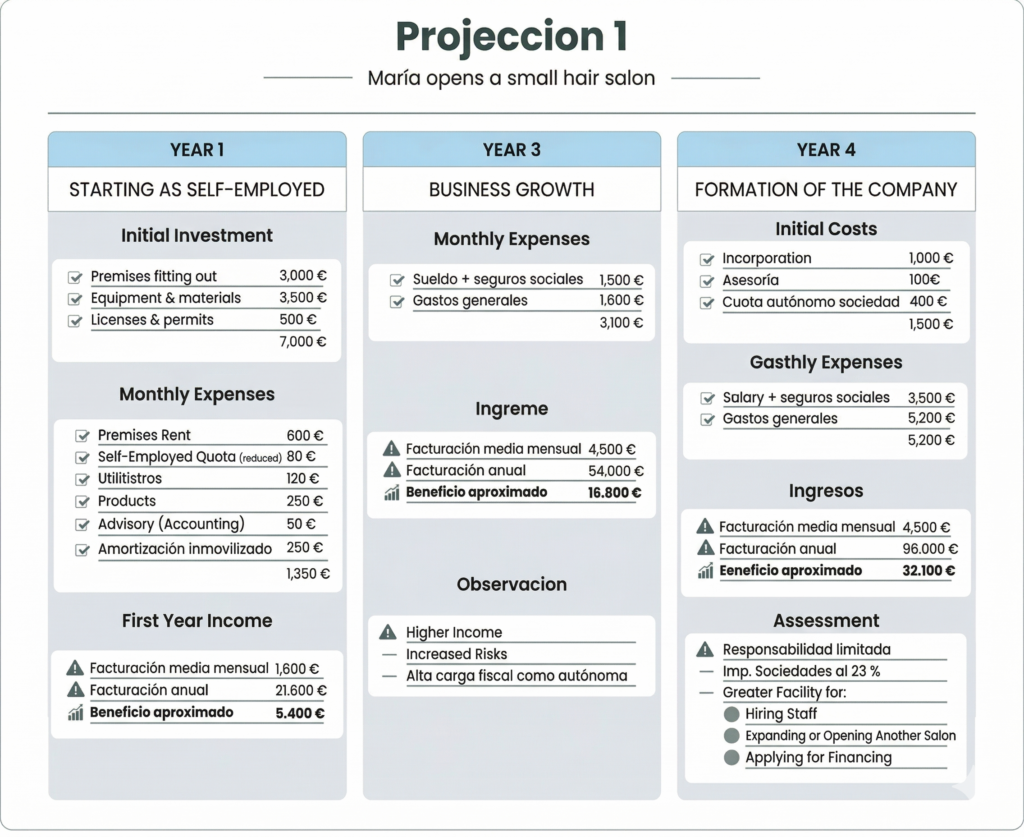
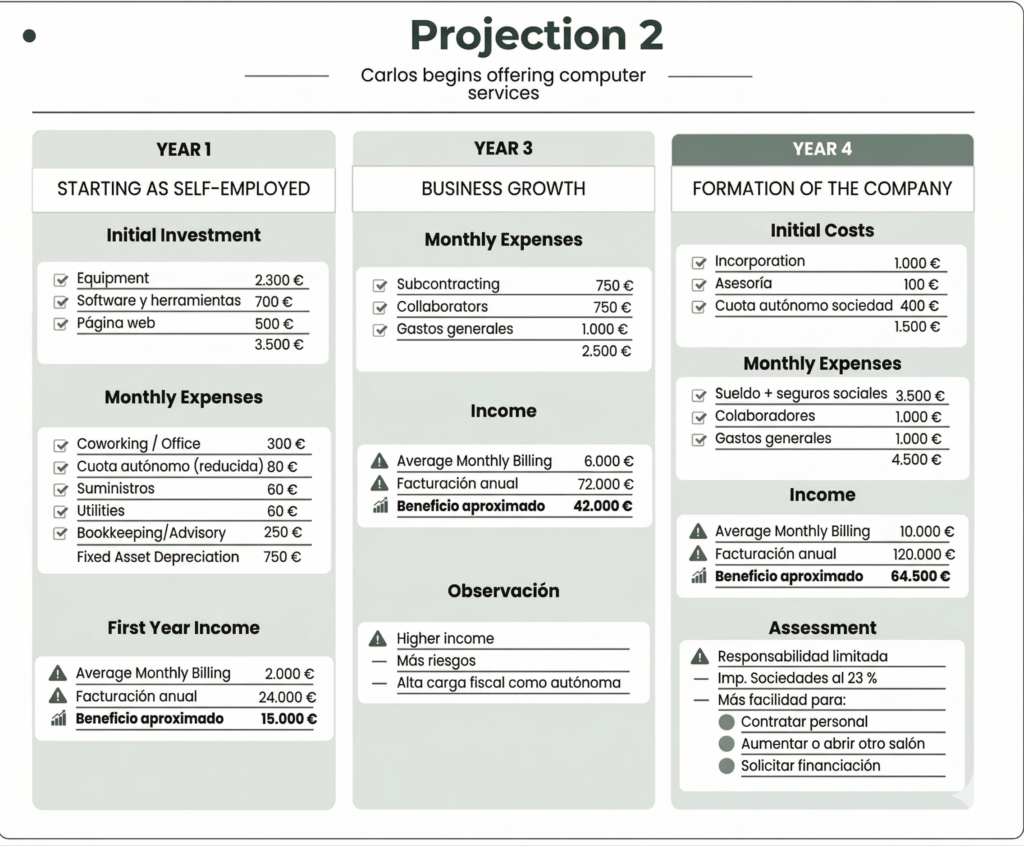
5. When should you switch from self-employed to a company?
Many entrepreneurs start as self-employed and transition to a company as their business grows.
It is usually advisable to set up a company when:
- Profits exceed €40,000–€50,000 per year
- There are significant financial or legal risks
- External investment is needed
- You need to expand your team
Example
SUMMARY
🔹 Self-employed → perfect for freelancers and consultants starting out
- Simple setup
- Lower costs
- Ideal for small businesses
🔹 Company → recommended from €50,000–€60,000 per year when scaling and optimizing taxes
- Greater asset protection
- Better professional image
- Tax advantages from certain income levels
In the Canary Islands, there are also tax incentives such as ZEC and RIC that may influence your decision:
| Feature | Canary Islands Special Zone (ZEC) | Reserve for Investments (RIC) |
|---|---|---|
| Mechanism | Reduced Corporate Tax rate of only 4% | Reduction of up to 90% of taxable base |
| Beneficiaries | Mainly newly created companies | Companies and self-employed with recurring profits |
| Investment | Minimum €100,000 / €50,000 in fixed assets in first 2 years | Profits must be reinvested in the Canary Islands within 3–4 years |
| Employment | Minimum of 3 to 5 permanent jobs | Can be used to create employment, but not required |