When we talk about indirect taxes in Spain, the most common reference is IVA (Value Added Tax). However, in the Canary Islands, there is a different tax that serves a similar purpose: IGIC (Canary Islands General Indirect Tax). Although both tax consumption, they present important differences that are worth knowing, especially if you run a business or carry out operations between territories.
📢 What is IVA?
IVA is an indirect tax applied in mainland Spain and the Balearic Islands. It taxes the consumption of goods and services and is paid by end consumers, although businesses and the self-employed are responsible for collecting it and paying it to the administration. In Spain, there are three types of IVA:
- General (21%)
- Reduced (10%)
- Super-reduced (4%)
This tax is harmonized at the European level, which facilitates trade between European Union countries. [+ info]
📢 What is IGIC?
IGIC is the equivalent of IVA in the Canary Islands. It is applied due to the islands’ special economic and fiscal regime, recognized by the European Union. Although its operation is similar to IVA, its tax rates are generally lower. The main types of IGIC are:
- General (7%)
- Reduced (3% and 0%)
- Increased (13.5% and higher in specific cases)
This makes the Canary Islands a territory with a lower indirect tax burden on consumption. [+ info]
Main Differences Between IVA and IGIC
1. Geographical Scope 🗺️
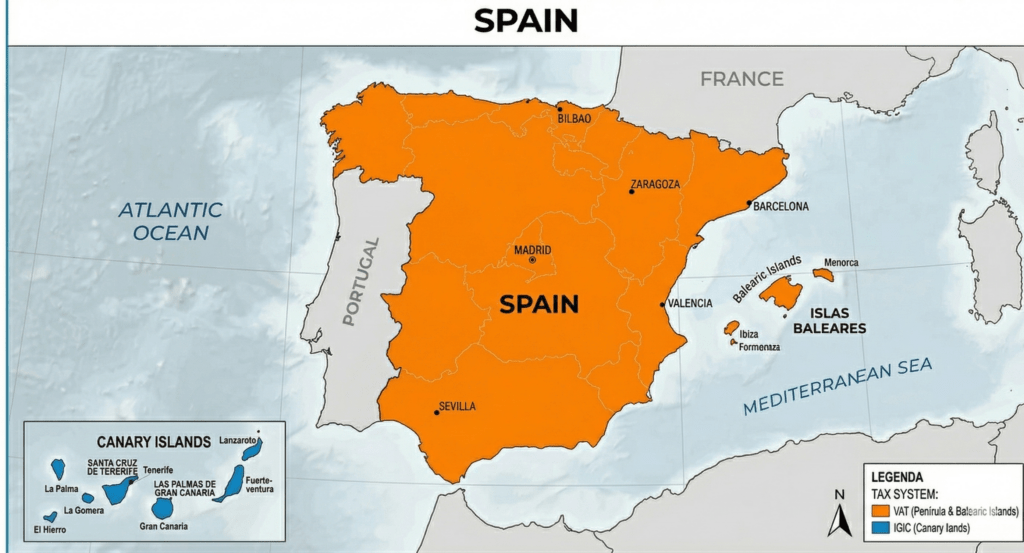
- IVA applies in the mainland and the Balearic Islands.
- IGIC applies exclusively in the Canary Islands.
2. Tax Rates ⚖️ IGIC has lower rates compared to IVA, which directly impacts the final price of goods and services.
3. Regulations 📜
- IVA is regulated by European Union directives.
- IGIC has its own regulations adapted to the Canary Islands’ special regime.
4. Operations Between Territories 📍 When operations are carried out between the mainland and the Canary Islands:
- No IVA is applied to exports to the Canary Islands.
- IGIC is applied upon importation into the Canary Islands. This may involve customs procedures and additional management.
🚨 Why is it important to know these differences?
Understanding how IVA and IGIC work is key to:
- Avoiding invoicing errors.
- Correcting complying with tax obligations.
- Optimizing your business’s financial management.
Furthermore, if you sell online or work with clients in the Canary Islands, knowing these particularities will help you offer better service and avoid fiscal surprises.
🖥️ When are IVA and IGIC filed?
One of the most common questions for both the self-employed and companies is knowing the filing deadlines. Although IVA and IGIC function similarly, their calendars can vary slightly.
📅 Filing IVA
IVA is filed periodically using Form 303 (quarterly or monthly self-assessment) and Form 390 (annual summary).
⌛ Quarterly Deadlines (most self-employed):
- 1st Quarter (January – March): April 1st to 20th
- 2nd Quarter (April – June): July 1st to 20th
- 3rd Quarter (July – September): October 1st to 20th
- 4th Quarter (October – December): January 1st to 30th
⏰ Monthly Filing (large companies):
- From the 1st to the 30th of the month following the corresponding period.
📊 Annual Summary (Form 390):
- Filed from January 1st to 30th of the following year.
📅 Filing IGIC
IGIC is filed using Form 420 (self-assessment) and Form 425 (annual summary).
⌛ Quarterly Deadlines:
- 1st Quarter: April 1st to 20th
- 2nd Quarter: July 1st to 20th
- 3rd Quarter: October 1st to 20th
- 4th Quarter: January 1st to 30th
⏰ Monthly Filing:
- There is also a monthly option for large companies, with deadlines similar to IVA (1st to 30th of the following month).
📊 Annual Summary (Form 425):
- Filed during the month of January of the following year.
⚠️ Important to Keep in Mind
- If the last day falls on a holiday or weekend, the deadline is extended to the next business day.
- Direct debits (bank payments) usually have a deadline a few days earlier (typically until the 15th or 25th, depending on the case).
- It is vital not to be late, as surcharges and penalties may apply.